





You can look polished without using a blow dryer, flat iron, or curling wand. The key is not a miracle product. It’s a system you can rely on, even when you’re in a hurry.
- Why Heat-Free Styling Works for Healthier Hair
- How reducing heat prevents breakage and split ends
- What “effortless hair styling” really looks like day to day
- How to set realistic expectations for texture and volume
- Know Your Hair Type and Texture Before You Build a Routine
- Fine vs. thick hair: what changes in a minimalist hair routine
- Straight, wavy, curly, and coily: choosing the right approach
- Porosity basics and why it affects frizz and hold
- Build a simple hair style routine That Fits Your Schedule
- Creating a 5-minute morning plan vs. a 15-minute plan
- Weekly rhythm: wash day, refresh days, and reset days
- How to keep an effortless hair routine consistent
- Minimalistic Hair Care Staples You Actually Need
- Wash Day Foundations for an Effortless Hair Routine
- Choosing a shampoo and conditioner for your goals
- Detangling techniques that minimize shedding
- Drying without heat: microfiber towel, T-shirt, and air-dry strategies
- Leave-Ins, Creams, and Oils for Minimal Effort Hair Care
- Lightweight vs. rich products: avoiding buildup
- Layering order for softness, definition, and hold
- How to spot over-moisturizing vs. protein needs
- Fast Hair Styling Techniques Without Heat
- Quick Hair Styling Techniques for Air-Dried Hair That Looks Polished
- Part changes and face-framing tricks for instant upgrade
- Smoothing flyaways without flattening volume
- Easy volume methods: root clips, strategic pinning, and lift
- Overnight Styling Methods for Effortless Hairdos
- Braids for waves: loose braid patterns and tension control
- Twists and Bantu knots for definition and stretch
- Heatless curls with rollers, rods, or socks
- Quick Hairstyle Tips for Busy Mornings
- Quick Hair Styling Hacks Using Accessories
- Claw clips, scrunchies, and pins for neat, fast styles
- Headbands and scarves, for instance, put-together looks
- How to choose accessories that reduce breakage
- Effortless Hair Care Between Washes
- Refreshing without heat: misting, reactivating products, and smoothing
- Dry shampoo and scalp care tips for everyday climate conditions
- How to prevent tangles and friction during the day
- Protective Styles That Keep a Minimalist Hair Routine Simple
- Common Mistakes That Ruin Heat-Free Results
- Using too much product and losing volume
- Touching hair while it dries and creating frizz
- Skipping trims and why it affects styling time
- Conclusion
This guide means skipping hot tools on purpose. You’ll use air-dry styling, gentle tension, wrapping, braiding, pinning, and overnight sets. With the right steps, your hair can look styled, not undone.
This is for you if you’re busy, rebuilding hair health, or want simpler mornings. A good, effortless hair routine should be calm and easy, not overwhelming.
We’ll help you create your simple hair style routine. First, you’ll find out your hair type and texture. Then, you’ll pick a few essential items and plan for your week. You’ll learn quick, heat-free ways to style your hair and overnight looks that last.
Changing your mindset is key. Your goal isn’t perfect hair. It’s dependable hair that looks good, feels comfortable, and protects your hair over time with an effortless routine you’ll stick to.
Why Heat-Free Styling Works for Healthier Hair
Switching to heat-free routines can feel like a fresh start. If your hair has been exposed to daily heat styling, it’s time for a break. This break allows your hair to hold onto moisture and stay elastic.
This change makes your hair easier to manage. You don’t have to force it into a new style every day. It’s all about letting your hair do what it naturally does.
If you’re looking for easy hair care, think long-term. Doing the same air-dry method or overnight set often leads to better results. Your routine becomes simpler as you learn what your hair likes best.


How reducing heat prevents breakage and split ends
High heat can dry out your hair’s outer layer, making it more prone to breakage. This layer protects each strand. When it gets rough, hair tangles and snaps more easily.
By using less heat, you help your hair stay longer. Fewer weak points mean fewer break points. Your hair will also feel softer, as you’re not drying out the moisture your conditioner adds.
What “effortless hair styling” really looks like day to day
Effortless hair styling doesn’t mean no effort at all. It means fewer choices and steps because your routine fits your hair and lifestyle. You wash, set, and let it dry with purpose, then refresh it in small ways.
A good minimal effort hair care routine includes a simple rhythm: cleanse, condition, set, and protect at night. You don’t change your routine every morning. Instead, you guide your hair back to its natural pattern.
- Wash day: define your part, add hold if you need it, and set your roots for lift.
- Refresh days: mist lightly, smooth frizz with a small amount of product, and re-pin sections that flattened.
- Night: protect with a loose bun, braids, or a wrap to reduce friction and preserve shape.
How to set realistic expectations for texture and volume
Heat-free styling gives you natural movement and texture. It might not be as sleek as a flat iron, but that’s okay. For a smoother look, try wrapping your hair or using a smoothing cream without high heat.
Volume comes from how you style your roots, not just from blowouts. Clipping at the crown or changing your part can add lift. This is where effortless styling really shines: it’s all about smart setup, not constant touch-ups.
| Goal | Heat-free approach | What you’ll likely notice |
|---|---|---|
| Less breakage | Lower friction detangling, air-dry or wrap, protect ends at night | Fewer snapped strands, smoother ends, better length retention over time |
| Smoother finish | Wrap hair while damp, use a small amount of smoothing product, and set with light tension | More polish with some natural texture showing |
| More volume | Root clips, pinning at the crown, part changes after drying, lightweight hold | Lift at the roots without the dryness that can follow frequent blowouts |
| Faster mornings | Overnight sets, consistent wash-day technique, quick refresh strategy | A steadier routine that supports minimal effort hair care and fewer decisions |
Know Your Hair Type and Texture Before You Build a Routine
Before you follow a trend, take a moment to understand your hair. A minimalist hair routine works best when it matches your hair’s thickness, density, and natural pattern.
Think of this as supportive styling, not “fixing” anything. When you build around your real texture, minimalistic hair care feels calmer. Your morning choices get simpler.
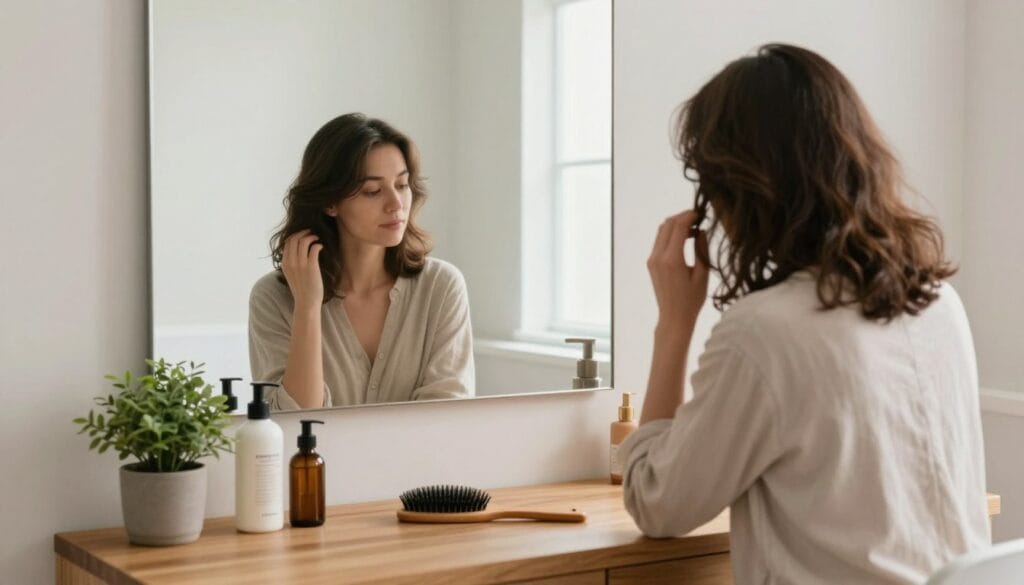
Fine vs. thick hair: what changes in a minimalist hair routine
Fine hair looks best with light layers and small amounts of product. Too much conditioner or cream can make roots fall flat, which can sabotage an effortless hair routine.
Thick hair usually needs more sectioning on wash day to get even coverage. Richer conditioning and “set it once” styles can help your shape hold, so you do less the next day.
| Hair feel | What to prioritize | Product texture | A heat-free technique that helps |
|---|---|---|---|
| Fine strands | Lift, light conditioning, clean roots | Sprays, foams, lightweight leave-ins | Root clips at the crown; switch your part after drying |
| Thick strands | Slip for detangling, even saturation, shape control | Creams, butters in small sections, richer masks | Braids or twists to set the pattern; roller sets for smooth bends |
| High density (lots of hair) | Time-saving sections and strong hold | Gel-cream combos in layers | Clip roots while air-drying to reduce bulk at the scalp |
| Low density (less hair) | Volume and fullness without buildup | Weightless stylers, dry texturizing sprays | Micro-plop with a T-shirt; avoid heavy oils near the roots |
Straight, wavy, curly, and coily: choosing the right approach
Straight hair often responds to low-friction drying and gentle wrapping to prevent random bends. Wavy hair tends to like scrunching and a light hold that keeps definition without crunch.
Curly and coily hair usually does best with moisture plus hold, layered in that order. For many people, twists, braid-outs, or Bantu knots can shrink styling time because the pattern dries with intention.
- Straight: smooth air-dry, careful towel pressure, fewer touch-ups
- Wavy: micro-plopping, scrunching, light gel for frizz control
- Curly/coily: detangle gently, layer leave-in + gel, stretch to set shape
Porosity basics and why it affects frizz and hold
Porosity is how fast your hair absorbs water and how quickly it loses it. If you deal with quick frizz and styles that fall apart, higher porosity may be part of the story.
Higher porosity often needs more sealing and a stronger hold to keep definition through the day. Lower porosity can prefer lighter layers and extra time for products to sink in, which helps an effortless hair routine stay smooth.
Once you know your type, your minimalist hair routine stops feeling like trial and error. Minimalistic hair care becomes a short set of choices that support your texture, not fight it.
Build a simple hair style routine That Fits Your Schedule
Your calendar is as important as your hair type. A simple hair style routine works best when it’s built in time blocks you can repeat, even on rushed weeks.
Think of your mornings in two lanes: the “just get out the door” lane and the “I have a little time” lane. Both can stay heat-free, polished, and realistic.

Creating a 5-minute morning plan vs. a 15-minute plan
In five minutes, aim for a quick refresh: mist, smooth, and reshape. Keep one accessory style ready, plus one save-the-day option like a low bun, a claw-clip twist, or a sleek pony.
If you have fifteen minutes, add small details that read as “done.” Re-define the front pieces, pin at the crown for lift, rework one braid or twist, or set two face-framing sections while you get dressed.
| Time block | Focus | What you do | Result, you’ll notice |
|---|---|---|---|
| 5 minutes | Refresh + control | Mist hair, smooth flyaways, re-part if needed, then finish with a claw clip twist or low bun | Neater shape with less frizz |
| 15 minutes | Polish + definition | Refresh, then re-define hairline pieces, add pins for lift, and tighten one braid or twist | More structure and a softer frame |
| 5 minutes | Backup plan | Switch to a sleek pony, secure ends, and keep tension gentle at the edges | Clean look that holds through the day |
Weekly rhythm: wash day, refresh days, and reset days
A weekly rhythm keeps you from starting over every morning. On wash day, cleanse, condition, detangle, and choose drying and styling steps that help your hair set the way you want.
Refresh days are about reviving shape and shine without a full redo. Reset days are your quiet helper: a quick scalp focus, a clean re-part, or a re-braid or re-twist to stretch the week.
How to keep an effortless hair routine consistent
Consistency feels easier when your space supports you. Keep your core products visible, pre-stage a few accessories, and stick to two or three heatless styles that fit your real life—workouts, commutes, and office dress codes included.
When you’re stuck, lean on quick hairstyle tips you can repeat without thinking: change your part, smooth the perimeter, and secure your style with one strong accessory. That’s the heart of an effortless hair routine that looks intentional.
Minimalistic Hair Care Staples You Actually Need
Think of minimalistic hair care like a capsule wardrobe. It’s about having fewer items, each with a clear purpose. This way, you avoid guessing and make your wash days smoother.

For easy hair care, focus on five key products. You need a gentle shampoo for your scalp, a conditioner that matches your hair’s needs, a leave-in for slip, a styler for hold, and a finisher for shine. The last step is key when used sparingly.
Effortless hair care also means using the right tools. A wide-tooth comb or detangling brush helps avoid breakage. A microfiber towel or soft cotton T-shirt reduces frizz when drying.
- Detangle smart: a wide-tooth comb or a detangling brush
- Dry gently: microfiber towel or cotton T-shirt
- Set and smooth: a few clips or pins, satin or silk scrunchies
- Protect overnight: satin or silk pillowcase or a bonnet
Choosing the right staples depends on your hair’s texture and scalp needs. Fine hair does well with lighter formulas. Thick, curly, or coily hair might need richer creams for slip and softness.
If your scalp gets oily, focus on good cleansing habits. Rinse well to avoid greasy roots. In minimalistic hair care, aim for clean roots, supported lengths, and a simple routine.
Setting boundaries is key to avoiding clutter in your hair care routine. If a product doesn’t improve your wash day, refresh day, or protection, it’s not needed. Effortless hair care should be calm and simple.
| Staple | Job in a heat-free routine | Best fit by hair need | Common slip-up to avoid |
|---|---|---|---|
| Gentle shampoo | Cleans scalp and removes buildup so hair dries lighter | Great for all types; helpful if you use stylers often | Scrubbing lengths instead of focusing on the scalp |
| Conditioner | Adds softness and helps detangle for less breakage | Fine hair: lightweight; thick/coily: richer formulas | Rinsing too fast and leaving knots behind |
| Leave-in | Boosts slip and hydration, so air-drying looks smoother | Dry ends, frizz-prone hair, or color-treated hair | Applying too close to the roots and losing volume |
| Styler (gel, mousse, or cream) | Creates hold and definition while hair sets without heat | Wavy: mousse or light gel; curly/coily: gel or cream | Layering too many stylers and getting buildup |
| Finisher (serum or light oil) | Softens flyaways and adds shine once hair is fully dry | Best for ends and the outer layer, especially in dry weather | Using too much and making hair look flat or oily |
| Microfiber towel or cotton T-shirt | Reduces frizz by limiting rough rubbing | Helpful for wavy, curly, and coily textures | Twisting too tightly and stressing the hairline |
| Satin/silk pillowcase or bonnet | Lowers friction overnight so you refresh faster | Great for all textures, especially prone-to-frizz hair | Skipping nightly protection and over-styling the next day |
Wash Day Foundations for an Effortless Hair Routine
Think of wash day as your setup day. When your hair is clean, conditioned, and shaped with intention, the rest of the week feels lighter. This is where an effortless hair routine starts to look real, not rushed.
With the right wash-day choices, minimalistic hair care stays simple. Your mornings lean on fast hair styling techniques instead of last-minute fixes.
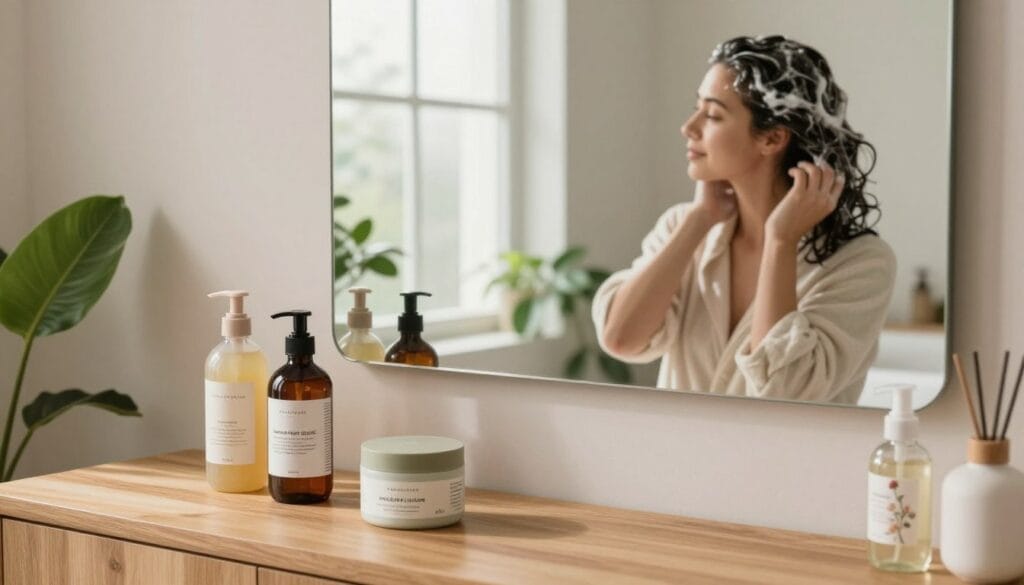
Choosing a shampoo and conditioner for your goals
If your scalp gets oily fast, aim your shampoo at the roots. Focus on a thorough rinse. Keep conditioner off the scalp so you don’t weigh down your hair or shorten the time between washes.
If your hair runs dry, put conditioner through mid-lengths and ends. Detangle while it’s slippery. A weekly deeper conditioning step can help, as long as it stays quick and doesn’t derail your effortless hair routine.
| What you notice | Wash-day focus | Simple payoff all week |
|---|---|---|
| Roots look oily by day two | Cleanse scalp well; rinse longer; keep conditioner on mid-lengths/ends only | Lift at the roots and fewer “re-wash” moments, which support fast hair styling techniques |
| Ends feel rough or dry | Condition generously on ends; detangle under conditioner; add a short weekly deep condition | Softer strands that bend, braid, and clip easily for a more effortless hair routine |
| Hair feels coated or dull | Use less product; emulsify shampoo in hands first; rinse until hair feels light | Better movement and bounce, keeping minimalistic hair care truly minimal |
Detangling techniques that minimize shedding
Detangle when your hair has conditioner in it and feels slick. Work in sections, start at the ends, and move up slowly so knots release instead of snapping.
Avoid aggressive brushing, which can damage your hair. Gentle, steady tension protects length and keeps your minimalistic hair care routine from turning into damage control.
Drying without heat: microfiber towel, T-shirt, and air-dry strategies
Skip rough towel rubbing. Use a microfiber towel or a soft cotton T-shirt to blot and gently squeeze out water. This reduces frizz.
Style while hair is damp, not dripping, so product spreads evenly. For waves, hairstyle & curls, scrunch and consider a short “plop,” then let the roots dry with lift. For straighter looks, smooth hair down with light tension and resist touching it as it sets—an easy anchor for fast hair styling techniques later in the week.
Leave-Ins, Creams, and Oils for Minimal Effort Hair Care
When you skip hot tools, products do more of the heavy lifting. The goal is simple: the right slip for detangling, plus enough hold for shape. With minimal effort and hair care, you’re not chasing “more”—you’re choosing what helps your hair behave on purpose.

This is also where effortless hair care starts to feel real. Once you know what your hair likes, quick hair styling techniques get easier. Your strands dry with a plan instead of a guess.
Lightweight vs. rich products: avoiding buildup
Lightweight leave-ins, sprays, and foams tend to keep movement and volume. They’re often a better match for fine hair or hair that gets limp fast. Rich creams and butters can be great for thicker, curlier textures that need longer-lasting moisture—just use them in smaller amounts.
Buildup is the warning sign that your routine needs a reset. If hair looks dull, feels coated, falls flat by midday, or seems to repel water in the shower, you may be layering too heavily. Minimal effort hair care works best when hair feels touchable, not covered.
| Product feel | Best use case | Common buildup signal | Simple adjustment |
|---|---|---|---|
| Lightweight leave-in (spray or lotion) | Slip for detangling, softening without flattening | Ends feel dry, but roots look fine | Apply to damp hair, focus on mid-lengths to ends |
| Foam or mousse | Definition and airy hold for waves and curls | Crunch that never softens | Use less product and scrunch with a towel once |
| Rich cream or butter | Moisture and clumping for tight curls and coils | Hair feels coated and dries slowly | Use a dime-size amount per section, and add water first |
| Oil (light to medium) | Seal ends, add shine, reduce friction | Greasy finish or stringy pieces | Rub 1–2 drops between palms, tap only the ends |
Layering order for softness, definition, and hold
A repeatable order keeps effortless hair care truly effortless. Start with hydration, then add shape, then seal only if needed. This structure helps your style set cleanly while you air-dry.
- Hydrate/condition: apply leave-in on damp hair for slip and softness.
- Define: choose one main styler—cream for richness, gel for stronger hold, or foam for lighter lift.
- Seal sparingly: smooth a tiny amount of oil on the ends if they fray or fuzz.
With that “trio,” quick hair styling techniques become more consistent. Your hair dries with better clumps, fewer flyaways, and less surprise shrinkage.
How to spot over-moisturizing vs. protein needs
Too much moisture can make hair feel overly soft and puffy, like it has no backbone. Styles may fall apart fast, even when you use a strong styler. If that sounds familiar, your routine may need less cream or fewer heavy layers.
Protein needs can show up as limp hair that lacks bounce and resilience, even when it’s not dry. Not everyone needs frequent protein, especially if your hair already feels strong. The sweet spot for minimal effort hair care is balance: soft enough to move, strong enough to hold shape for effortless hair care days, and reliable, quick hair styling techniques.
Fast Hair Styling Techniques Without Heat
When you need quick results, the best techniques don’t fight your hair. Instead, they follow its natural pattern. This way, quick hairstyle tips become effortless hairdos you can easily repeat.

Think of your routine as a small menu. You can choose from air-dry shaping, pin-and-set methods, braids, twists, and simple accessories. Each option works best with light hands and consistent steps. Over time, your hair will learn the pattern and become easier to manage.
| Your goal | Heat-free technique | How to do it fast | What to avoid |
|---|---|---|---|
| Smoother finish | Tension drying + wrap | After washing, smooth hair into its natural direction, then secure a low wrap with pins while it sets. | Over-brushing once it starts drying, which can raise frizz and swell. |
| Texture and definition | Scrunch + mini finger-coils | Scrunch with a light-hold product, then coil only a few face-framing pieces for polish. | Heavy creams at the roots can cause the shape to collapse. |
| More volume | Root direction + crown clips | Flip your part for a few minutes, clip at the crown, and let the roots dry lifted. | Applying oils near the scalp, which can weigh hair down fast. |
| Neat and secure | Pin-and-set or claw-clip style | Twist loosely, pin where you want lift, or clip at the back for a clean line. | Too-tight tension that can stress edges and cause soreness. |
For smoother hair, use gentle tension instead of force. Smooth with your palms, then wrap or pin it in place. Only brush when you need to. Finish with a small amount of smoothing product, focusing on the ends.
For texture, air-dry shaping is key. Scrunch while damp, then leave it alone as it sets. For a polished look, add finger coils just on the face-framing pieces.
For volume, focus on the roots. Change your root direction, clip at the crown, and keep the product away from the scalp. These techniques are simple yet effective, leading to great results.
The secret to effortless hairdos is care, not speed alone. Handling your hair the same way each time leads to predictability and less frizz. This is why the fastest routines are often the ones you can stick with.
Quick Hair Styling Techniques for Air-Dried Hair That Looks Polished
Air-dried hair can look as polished as a blowout with the right techniques. Focus on shape, not perfection. Use tiny tweaks that make a big difference in real-life lighting.
Set a simple goal: calm the halo, frame your face, and keep some lift. This is the sweet spot for effortless hair styling that looks “done.”

Part changes and face-framing tricks for instant upgrade
Changing your part is the fastest way to refresh your hair without re-wetting it. Try a soft side part if you’ve been center-parted. Or, shift closer to the center if you always go to the side for a cleaner look.
Refine only the front sections. Mist your fingertips with water, smooth the first inch near your hairline, and tuck or pin where you want the curve to sit. This quick tip makes your hair look polished, even when it’s natural.
Smoothing flyaways without flattening volume
Flyaways need a light touch, not more product. Warm a small amount of smoothing cream or hair oil between your fingers, then tap it over the frizziest spots. Aim for the surface only to avoid flattening your roots.
For extra control, use a clean toothbrush-style edge tool to press down fuzz along the part and temples. If it’s humid, tie a soft scarf over the top for three to five minutes. This keeps your lift while calming the halo.
Easy volume methods: root clips, strategic pinning, and lift
Volume lasts longer when hair dries in the direction you want it to lie. Clip at the crown while your hair finishes air-drying, placing the clip at the root and lifting, not back. If your hair is already dry, pin the root in the opposite direction for a few minutes to “reset” the bend.
Try this quick plan for effortless hair styling that holds:
- Root clips: 2–4 clips at the crown, set for 10–20 minutes.
- Strategic pinning: pin one front section back to open the face, then remove it before you walk out.
- Cool set: keep hair lifted until it’s fully dry to lock in shape.
| Polished tweak | Best for | How long does it take | What you’ll notice in photos |
|---|---|---|---|
| Soft side part shift | Flat crown, grown-out layers | 30–60 seconds | More asymmetry and face definition |
| Front-section refine (mist + tuck/pin) | Uneven dry pattern near the hairline | 1–2 minutes | Cleaner outline around cheeks and jaw |
| Fingertip smoothing + edge tool | Halo frizz, flyaways at temples | 1 minute | Sleeker top without a “slicked-down” look |
| Root clips + full dry “cool set.” | Hair that falls flat by lunch | 10–20 minutes (hands-off) | Lift at the crown that looks natural |
These quick hair styling techniques aren’t about perfect symmetry. They’re about a confident shape that frames your face and holds up to your day. They’re quick tips that fit into real mornings.
Overnight Styling Methods for Effortless Hairdos
Mornings can be busy, but overnight styling makes a big difference. It sets your hair while you sleep, so you just need a quick touch-up in the morning. This is a key part of an easy hair routine.

Begin with hair that’s almost dry or evenly damp. Wet hair can dry with weird bends and feel limp. Using a satin bonnet or silk scarf helps keep your hair smooth.
Braids for waves: loose braid patterns and tension control
Braids are easy for soft waves. The size of the braids matters. One or two loose braids give beachy waves, while many small braids add texture.
Be gentle when securing the ends with a soft scrunchie. In the morning, gently unravel and separate with your fingers. This patience pays off with shiny, defined hair.
Twists and Bantu knots for definition and stretch
Twists are perfect for definition and stretch, great for shrinking hair. Use clean parts and even sections, twisting down with light tension. This keeps your hair aligned and easy to detangle later.
Bantu knots are for tighter curls and extra lift at the roots. Keep each knot snug but not tight. When you take them down, separate them slowly to avoid frizz.
Heatless curls with rollers, rods, or socks
For tighter curls, try foam rollers, flexi rods, or sock curls. Bigger tools make looser curls, while smaller ones create tighter spirals. Choose what you can sleep in comfortably.
Wrap ends smoothly to avoid kinks. Let hair cool and settle for a few minutes before unraveling. Then, shake at the roots and smooth flyaways with care. This keeps your hair looking polished.
| Overnight method | Best for | How to set it | Morning takedown tip |
|---|---|---|---|
| Loose braids | Soft waves and natural volume | Mostly dry hair, 1–2 braids, gentle tension, ends secured with a scrunchie | Unbraid slowly, separate with fingertips, avoid over-fluffing to limit frizz |
| Small braids | More defined texture and long-lasting wave pattern | Evenly damp hair, multiple sections, consistent braid size for a uniform result | Open each braid fully before separating; focus on roots last for control |
| Two-strand twists | Definition with stretch and less shrinkage | Neat sections, light product if needed, steady twist tension, ends tucked softly | Twist apart in the same direction you twisted; separate into small pieces |
| Bantu knots | Tighter curls, root lift, and springy shape | Medium sections, coil and wrap into a knot, comfortable tension at the hairline | Let hair settle, then unravel and separate gently to keep curl clumps intact |
| Foam rollers / flexi rods/sock curls | Structured curls from loose to tight, depending on tool size | Smooth ends, wrap evenly, choose larger tools for comfort, and softer curls | Remove from the bottom up, then shake at the roots and smooth the top lightly |
Quick Hairstyle Tips for Busy Mornings
Busy mornings are easier when you use quick hairstyle tips that match your hair type. Stick to a few simple styles you can do without thinking. This way, you’ll save time and get out the door on time.

Before you start styling, quickly check your hair in the mirror. Look at your roots for oil or flat spots, your ends for dryness or frizz, and your front for framing. This quick check helps you choose the right style without starting over.
- Roots: greasy, flat, or stuck in one direction
- Ends: fuzzy, dry, or bent from sleeping
- Front: cowlicks, uneven part, or pieces that need shaping
Styling in the right order saves time. First, do a loose hold (clip or soft bun) to keep hair out of your way. Then, get dressed and do your makeup. Finish with hair, making light adjustments to avoid frizz.
These tips cover the best styles for busy mornings. Mix them up to keep your routine fresh, even when you’re in a rush.
| Default style | When it works best | Fast steps | Polish points that matter |
|---|---|---|---|
| Low bun (sleek) | Oily roots, puffy sides, humid days | Center or deep side part, smooth into a low bun, and pin the base | Clean part line, secure base that doesn’t tug, soft face-framing pieces |
| Low bun (textured) | Dry ends, day-two waves, thick hair | Gather low, twist once, wrap loosely, pin ends under | Intentional “undone” shape, controlled flyaways, even tension at the nape |
| Ponytail upgrade | Flat crown, workout schedule, fine hair | Flip your part, lift the crown with fingers, tie, wrap a small strand around the elastic | Volume at the root, smooth perimeter, elastic hidden for a cleaner finish |
| Half-up, half-down | Frizzy ends, but decent roots, grown-out layers | Take the top section, secure with a clip or elastic, and loosen slightly at the crown | Balanced shape, face-framing pieces kept intentional, no pulling at temples |
| Twist-and-clip | Rushed commute, curls needing a reset, heavy hair | Gather back, twist upward, clip vertically, tuck ends | Clip placed on the “ridge” of the twist, clean sides, comfortable hold |
If you only have one minute, focus on polished points. A crisp part, controlled flyaways, and a secure base can make any style look planned. That’s the power of quick hairstyle tips you can use every day.
Quick Hair Styling Hacks Using Accessories
Accessories can make a big difference in your hair routine. They help you look great in minutes, with less effort. Keep a few quick styling tools handy for a polished look without heat.


Claw clips, scrunchies, and pins for neat, fast styles
A medium claw clip is great for effortless styles. Try a French twist: gather hair at the nape, roll upward, fold the ends in, then clamp. Make sure the twist is snug but not too tight.
For a low pony, use a satin scrunchie to reduce hair breakage. If your roots are flat, use two bobby pins at the crown. Lift a small top section, then cross the pins like an “X” under it for subtle height. A half-up style also works fast—pull back just the sides to frame your face and keep the rest airy.
Headbands and scarves, for instance, put-together looks
A headband can hide a bad hair day without extra product or heavy styling. Slide it in place, then gently tug a few face-framing pieces forward. This makes the look soft, not stiff.
A scarf is useful in humid or windy weather. Fold it into a band to smooth the hairline and protect edges, or tie it over a low bun for an instant upgrade. Scarves control flyaways while keeping your hands out of your hair.
How to choose accessories that reduce breakage
Choose accessories carefully to avoid hair damage. Look for smooth seams, coated elastics, and rounded teeth on clips. Avoid sharp metal edges and tiny rubber bands unless they’re made for hair and you remove them slowly.
Shopping at places like Target or Sephora often means finding satin or silk options. These materials create less friction than rough fabric. The best styles come from gentle tension—secure enough to hold, soft enough to keep breakage down.
| Accessory | Fast style idea | What to look for | Why does it support a minimalist hair routine |
|---|---|---|---|
| Claw clip | French twist, low chignon, half-up clamp | Rounded teeth, strong spring, smooth finish | Holds shape with less pulling, so you restyle less |
| Satin scrunchie | Low pony, low bun, braid tie-off | Soft fabric, covered elastic, no exposed seams | Less friction at the tie point for everyday wear |
| Bobby pins | Pinned crown lift, side sweep, hidden hold at the nape | Coated tips, smooth edges, firm grip | Targeted hold for quick hair styling hacks without over-brushing |
| Headband or scarf | Root-day camouflage, hairline smoothing, bun wrap | Soft backing, flexible fit, non-scratch fabric | Creates effortless hairdos while reducing daily manipulation |
Effortless Hair Care Between Washes
Between washes, you’re not trying to recreate wash day. You’re keeping your shape, comfort, and confidence. Think of it as effortless hair care that supports your style, even when your schedule is full.
When your plan stays simple, your effortless hair routine feels easier to repeat. And on the mornings you need speed, a few quick hair styling techniques can bring everything back into focus.

Refreshing without heat: misting, reactivating products, and smoothing
Start with controlled misting, not a full soak. Spray water lightly, then add a pea-sized amount of leave-in only if your ends feel rough. Target the areas that show it first—often the crown, hairline, and part.
If your hair is wavy or curly, re-scrunch to wake up the pattern. If it’s straighter, smooth with your palms and a tiny bit of cream on the outer layer. This kind of touch-up counts as a quick hair styling technique because you’re fixing what’s visible and letting the rest be.
Dry shampoo and scalp care tips for everyday climate conditions
In humid states, sweat and moisture can flatten roots fast. In dry winters, your scalp may feel tight while your lengths stay fine. Dry shampoo can help manage oil, but keep it light and focused at the roots.
Use short bursts, let it sit for a minute, then massage with fingertips to break up residue. If you notice an itch or heavy buildup, scale back and plan a thorough cleanse on wash day. Effortless hair care includes scalp comfort—it’s part of a sustainable routine.
| Weather conditions | What your scalp may do | Between-wash move | What to avoid |
|---|---|---|---|
| High humidity + commuting | Feels damp, roots collapse | Use dry shampoo at the part and crown; lift roots with fingers | Piling on heavy oil at the scalp |
| Hot summer workouts | Sweat + salt at the hairline | Mist the hairline, blot with a clean towel, then smooth flyaways | Scratching aggressively, which can irritate the skin |
| Cold, dry winter air | Tightness, flaky patches | Massage scalp gently; keep dry shampoo to a minimum, and cleanse well later | Layering dry shampoo day after day without a reset |
How to prevent tangles and friction during the day
Friction is a quiet style killer. For errands, try a low-tension bun or a loose braid to reduce rubbing on your ends. If brushing dry hair makes it puff or frizz, switch to finger-detangling and only where it’s knotted.
At night, satin or silk helps cut down on tangles and breakage, so you wake up with less work. That’s effortless hair care in real life: a few small habits that keep your look lived-in, polished, and ready for quick styling when needed.
Protective Styles That Keep a Minimalist Hair Routine Simple
Protective styling is all about reducing hair friction and handling. It’s about quick, easy styles that keep your hair looking good without taking too much time. You want hair days that feel like you, but with less effort.

For minimalistic hair care, think simple and comfortable. Braids and twists can protect your hair from getting caught. Low buns and updos also shield your hair from rubbing against clothes and backpacks.
The best styles don’t pull on your hairline. Make sure they’re loose enough for easy eyebrow movement. Change up your part and bun placement to avoid hairline stress.
Protective styles should also let you take care of your scalp. They should allow for regular moisturizing and cleaning. If you experience pain, bumps, or thinning, it’s a sign to adjust your style.
These styles are great for busy times. They work well for travel, long workweeks, and after having a baby. You can easily switch them up a few times a week, keeping your hair care simple.
| Protective style | Why it works (friction + ends) | Keep it truly protective | Best-fit schedule moments |
|---|---|---|---|
| Two to six loose braids | Reduces tangles and keeps ends bundled | Don’t braid tightly at the hairline; re-braid if frizz turns into knots | Travel days, gym weeks, humid weather |
| Flat twists or chunky twists | Limits daily manipulation and helps curls stay defined | Vary direction and placement to avoid stress in one area | Postpartum seasons, busy mornings, wash-to-wash stretch |
| Low bun with ends tucked | Keeps ends from scraping collars and seat belts | Use light tension; change the bun height to protect the same edges | Workweeks, meetings, “need it neat” days |
| Tuck-and-pin roll | Hides ends and smooths the surface without heat | Pin gently; avoid sharp clips that snag strands | Coat season, errands, quick polished look |
| Contained updo (claw clip or pinned twist) | Stops constant touching and keeps hair off your shoulders | Keep the clip off fragile edges; reposition daily | Long days, commuting, low-maintenance styling |
Common Mistakes That Ruin Heat-Free Results
Starting a heat-free routine can be tricky, even when you think you’re doing it right. Most problems stem from timing, amount, and small habits. Adjusting these can make effortless hair styling much easier.

Using too much product and losing volume
It’s easy to add extra cream or oil, thinking it’s better to be safe. But too much can weigh down your hair, making it look greasy and dull.
Start with a small amount and add more to dry spots, like mid-lengths and ends. If your hair is flat, try using less and spreading it with wet hands for better coverage.
Touching hair while it dries and creating frizz
Adjusting your hair while it’s drying can ruin your style. Brushing or re-parting too much can cause frizz and an uneven shape.
Here’s a simple trick: set it, clip it if needed, and let it dry fully before adjusting. Once dry, you can gently shake or soften your hair without messing up your style.
Skipping trims and why it affects styling time
Not getting regular trims can add minutes to your morning routine. Split ends tangle more, look fuzzy, and need more product and effort to smooth out.
Clean ends make your styling faster and easier. This is the essence of minimal effort hair care: fewer fixes, tools, and time spent on polish.
| Mistake | What you notice | Small change that helps | Why does it support heat-free results |
|---|---|---|---|
| Over-applying creams or oils | Flat roots, greasy look by day two, dull finish | Use half the amount; apply to mid-lengths and ends first | Keeps volume airy and reduces buildup that can block moisture balance |
| Handling hair while it’s drying | Frizz halo, uneven bend or curl pattern, “puffy” texture | Clip the part, stop touching, and wait until fully dry to adjust | Let’s hair set in place so the shape holds without heat or extra product |
| Delaying trims for too long | More knots, more snagging, ends that won’t look smooth | Trim on a steady schedule that matches your growth and breakage | Reduces tangles and makes styling faster with less manipulation |
If your results aren’t what you want, don’t worry. A small change, like less product, a better drying pause, or a trim, can make a big difference. It brings your routine back to effortless hair styling with minimal effort.
Conclusion
A simple hair style routine without heat is all about making three key choices. First, know your hair type and texture. Second, prepare well on wash day. Lastly, stick to easy patterns for busy mornings or overnight.
Working with your hair’s natural characteristics helps you achieve consistent results. This approach is the heart of an effortless hair routine.
Simple doesn’t mean dull. Small changes like a different part or a soft headband can make a big difference. Brands like Ouai and Briogeo offer products that complement this philosophy, helping to keep your look polished without needing a lot of time or products.
Consistency is key. Choose one wash-day method, two or three heatless styles, one refresh technique, and a protective option for busy times. This plan makes your hair routine easy to follow, even when life gets hectic.
Your hair doesn’t need to look the same every day to be beautiful. Treat it gently, avoid harsh treatments, and let its natural pattern shine. Focus on the quick tips that work for you and let go of the rest.